

How Optical DO Sensors Help Reduce Wastewater Aeration Energy
1. Why Aeration Energy Matters in Wastewater Treatment
Aeration is one of the most energy-intensive processes in wastewater treatment plants (WWTPs), often accounting for approximately 40–60% of total plant electricity consumption, depending on plant design and operating conditions.
In activated sludge systems, microorganisms require dissolved oxygen (DO) to degrade organic pollutants and support nitrification. However, excessive aeration wastes electricity, while insufficient aeration can compromise treatment performance and effluent quality.
Accurate, continuous dissolved oxygen monitoring is therefore essential for balancing biological oxygen demand with energy consumption. Optical dissolved oxygen sensors provide a reliable solution for intelligent aeration control.
2. How Optical Dissolved Oxygen Sensors Work
Optical DO sensors operate using fluorescence quenching technology. A light source excites an oxygen-sensitive fluorescent material, and the presence of oxygen changes its luminescence lifetime. The sensor measures this change and calculates the dissolved oxygen concentration.
Compared with traditional electrochemical DO sensors, optical DO sensors offer several advantages:
● No oxygen consumption during measurement.
● No electrolyte replacement or polarization time.
● Reduced dependence on water flow.
● Excellent long-term measurement stability.
● Lower routine maintenance requirements.
● Continuous real-time digital monitoring.
These characteristics make optical DO sensors particularly suitable for continuous monitoring in wastewater aeration tanks.
3. How Optical DO Sensors Reduce Aeration Energy Consumption
Preventing Over-Aeration
Traditional wastewater treatment plants may operate blowers at fixed speeds or according to predetermined schedules, regardless of actual oxygen demand.
Real-time dissolved oxygen monitoring allows operators to adjust airflow dynamically, preventing unnecessary oxygen supply and reducing blower electricity consumption.
Enabling Automatic Aeration Control
Optical DO sensors can be integrated with PLCs, SCADA systems, and variable frequency drives (VFDs) to establish a closed-loop aeration control system.
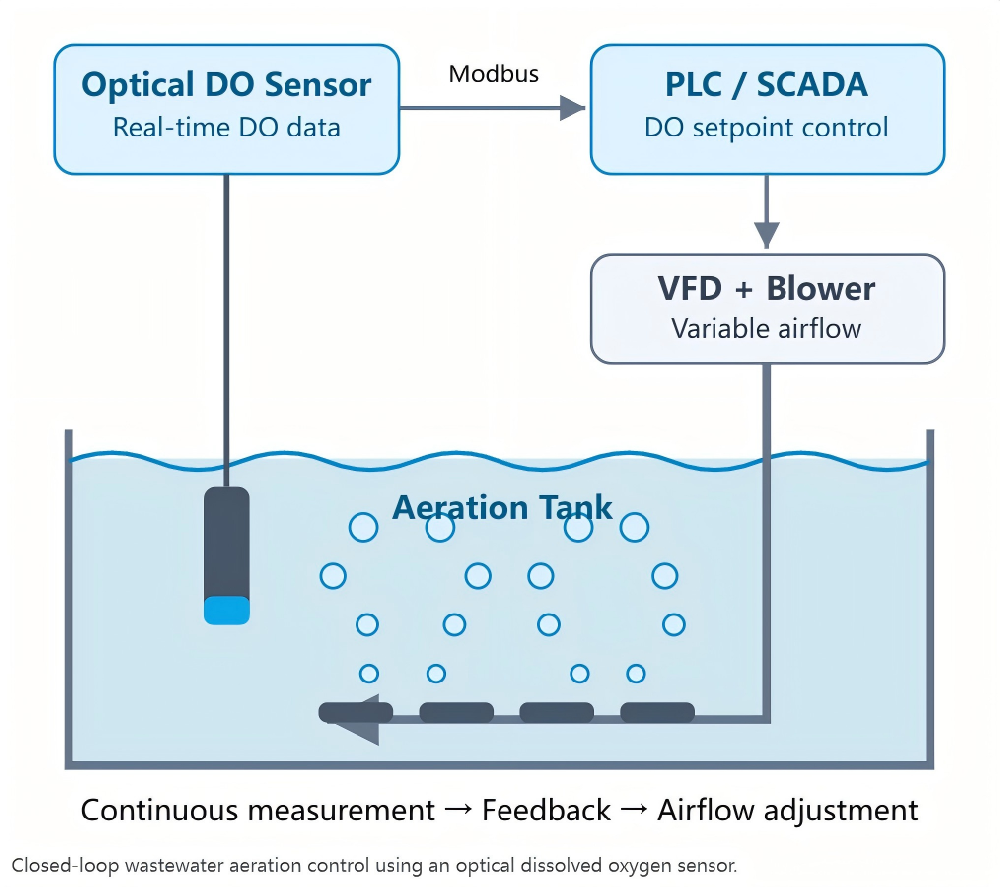
When the measured DO concentration exceeds the target value, the control system reduces blower speed or airflow. When DO falls below the target, airflow increases automatically.
This ensures that oxygen delivery matches actual process requirements.
Optimizing Dissolved Oxygen Setpoints
Many conventional activated sludge systems operate at DO concentrations of approximately 1.5–2.5 mg/L. However, the optimal setpoint depends on wastewater characteristics, temperature, biological loading, and treatment objectives.
Accurate optical DO monitoring enables operators to optimize setpoints while maintaining effective organic pollutant removal and nitrification.
Improving Oxygen Transfer Efficiency
Maintaining an appropriate DO concentration increases the driving force for oxygen transfer from air bubbles into wastewater compared with operating at unnecessarily high DO levels.
Combined with efficient diffusers and intelligent blower control, optical DO monitoring can improve overall aeration efficiency.
5. Optical DO Sensors vs. Traditional Electrochemical DO Sensors
Feature | Optical DO Sensor | Electrochemical DO Sensor |
|---|---|---|
Measurement principle | Fluorescence quenching | Electrochemical reaction |
Oxygen consumption | None | Yes |
Electrolyte replacement | Not required | Generally required |
Flow dependency | Low | Relatively high |
Routine maintenance | Low | Relatively high |
Long-term monitoring | Excellent suitability | Requires more maintenance |
Automatic aeration control | Highly suitable | Suitable |
6. Typical Wastewater Treatment Applications
Optical dissolved oxygen sensors can support energy-efficient aeration across various wastewater treatment processes:
● Municipal wastewater treatment plants
● Industrial wastewater treatment systems
● Activated sludge processes
● Membrane bioreactors (MBR)
● Sequencing batch reactors (SBR)
● Oxidation ditches
● Biological nitrification and denitrification systems
Proper sensor installation, regular cleaning, calibration verification, and representative measurement locations are essential for reliable automatic aeration control.
7. Yosemitech Optical DO Sensors for Wastewater Treatment
Yosemitech provides optical dissolved oxygen sensing solutions designed for continuous online water quality monitoring.
The Yosemitech Y504-A Optical Dissolved Oxygen Sensor uses fluorescence-based measurement technology and supports RS485 Modbus communication, facilitating integration with industrial automation and wastewater monitoring systems.
Combined with intelligent aeration control, Yosemitech optical DO sensors can help wastewater treatment facilities reduce unnecessary energy consumption, improve operational stability, and lower maintenance costs.
Learn more at Y504-A Online Optical Dissolved Oxygen Sensor-Water Quality Sensor Manufacturer-Yosemitech.
8. Conclusion
Optical dissolved oxygen sensors are an essential component of energy-efficient wastewater treatment. By providing reliable, continuous oxygen measurements, they enable demand-based aeration, reduce unnecessary blower operation, and support stable biological treatment performance.
Integrating optical DO sensors with intelligent automation systems is a practical approach to achieving lower operating costs, reduced carbon emissions, and more sustainable wastewater treatment.
 Y505-A Optical DO Sensor for Aquaculture
 Y504-A Online Optical Dissolved Oxygen Sensor
 Y600-A&Y507-A Portable Dissolved Oxygen Meter