

Reagent-Free COD Sensors: Benefits and Limitations
Chemical Oxygen Demand (COD) is one of the most important indicators used to evaluate organic pollution in water and wastewater. It represents the oxygen equivalent required to chemically oxidize substances in a water sample under specified test conditions.
Traditional COD testing methods typically require chemical reagents, sample digestion, and laboratory equipment. Although these methods are widely established, they can involve considerable operating costs, chemical waste generation, and delays in obtaining results.
As industries increasingly demand continuous water quality monitoring, reagent-free COD sensors have emerged as an attractive alternative for real-time process monitoring.
These sensors typically use ultraviolet (UV) absorption or UV-visible spectroscopy to estimate COD concentrations without adding chemical reagents during routine measurement.
However, reagent-free technology also has important limitations. Understanding both its advantages and measurement challenges is essential when selecting the right COD monitoring solution.
1. What Is a Reagent-Free COD Sensor?
A reagent-free COD sensor is a water quality monitoring instrument that estimates chemical oxygen demand without consuming chemical reagents during routine measurements.
Unlike conventional COD analyzers that rely on chemical oxidation reactions, optical COD sensors measure the interaction between light and dissolved or suspended substances in water.
Common optical technologies include:
• UV254 absorption: Measures ultraviolet light absorption near 254 nm, which is associated with certain organic compounds.
• Multi-wavelength UV-Vis spectroscopy: Analyzes absorption at several wavelengths to improve organic matter characterization and support interference compensation.
• Optical sensors with turbidity compensation: Use additional optical measurements or mathematical models to reduce interference caused by suspended particles.
Importantly, optical COD sensors do not directly measure the oxygen consumed during chemical oxidation. Instead, they estimate COD using correlations between optical signals and reference COD measurements.
This distinction is critical when evaluating measurement accuracy and regulatory suitability.
2. How Do Reagent-Free COD Sensors Work?
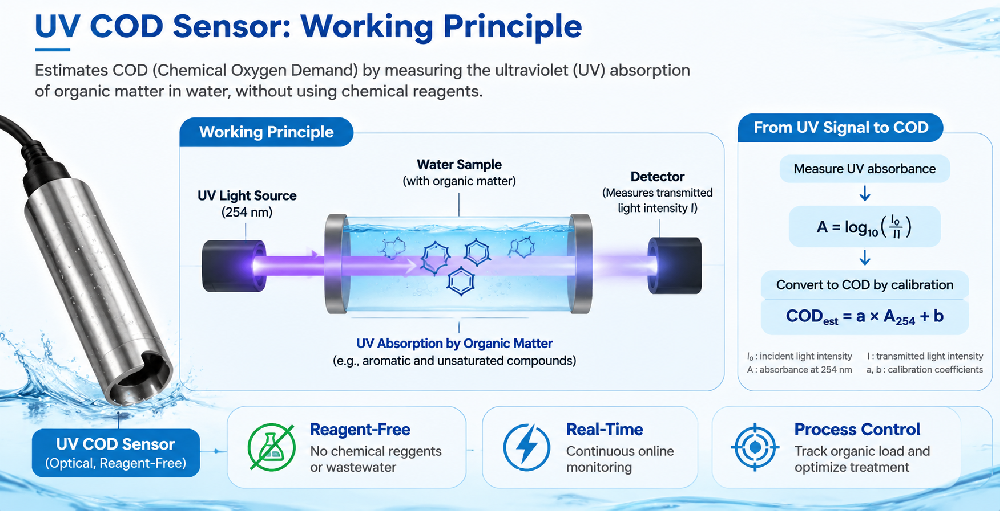
1. A UV light source transmits light through the sample.
2. UV-absorbing substances reduce transmitted intensity.
3. A photodetector measures the remaining light.
4. Calibration algorithms convert optical measurements into an estimated COD concentration.
3. Key Benefits of Reagent-Free COD Sensors
3.1 No Chemical Reagents During Routine Measurement
Reduces reagent handling, chemical waste, consumable replacement and operator exposure. Laboratory reference testing may still require chemicals.
3.2 Real-Time and Continuous Monitoring
Provides frequent measurements for detecting organic loading changes, tracking treatment performance and supporting process control. Conventional digestion methods can take considerably longer.
3.3 Lower Routine Operating Costs
Can reduce reagent and disposal costs, although ownership costs also include the sensor, cleaning, calibration, spare parts and reference testing.
3.4 Automated System Integration
Depending on the model, RS485 Modbus and related interfaces allow connection to PLC, SCADA and industrial IoT monitoring systems.
3.5 Reduced Environmental Impact
Eliminates routine chemical digestion inside the sensor, reducing chemical use and associated waste.
4. Limitations of Reagent-Free COD Sensors
4.1 COD Is Estimated, Not Directly Measured
Different organic compounds absorb UV light differently. Samples with identical laboratory COD may yield different UV absorbance. Site-specific calibration is often essential.
4.2 Turbidity and Suspended Solids
Particles scatter and attenuate light, introducing bias. High-solids wastewater may need cleaning, compensation or pretreatment.
4.3 Changing Wastewater Composition
Industrial process changes can alter the UV-to-COD relationship. Nitrate, nitrite, iron species and color may also interfere under some conditions.
4.4 Optical Window Fouling
Biofilms, minerals and solids can accumulate on windows and cause drift. Automatic cleaning helps but does not eliminate maintenance.
4.5 Regulatory Compliance
Optical COD estimates cannot automatically replace approved reference methods. Regulatory acceptance depends on the jurisdiction and method approval.
5. Reagent-Free COD Sensors vs Traditional COD Analyzers
Feature | Optical COD sensor | Chemical COD analyzer |
Principle | UV / UV-Vis correlation | Chemical oxidation |
Routine reagents | No | Yes |
Speed | Typically seconds to minutes | Often tens of minutes to hours |
Continuous monitoring | Well suited | Possible with automation |
Chemical waste | None from optical measurement | Generated |
Interference | Matrix and optical effects | Method-dependent |
Regulatory role | Requires acceptance / verification | Approved methods available |
Maintenance | Optics and calibration | Reagents, fluidics and digestion |
6. Applications
Municipal wastewater treatment
Track influent organic loading and treatment trends.
Industrial wastewater
Monitor variable waste streams after validating sensor suitability.
MBR and advanced treatment
Pair optical monitoring with suitable sample handling for challenging matrices.
Surface water
Track changes in UV-absorbing organic matter and potential pollution events.
7. How to Improve Measurement Accuracy
• Perform site-specific calibration against representative laboratory COD measurements.
• Evaluate turbidity, suspended solids, color, nitrate, iron and organic composition changes.
• Clean and inspect optical windows on a schedule matched to fouling conditions.
• Use pretreatment carefully: filtration can remove particulate COD and change the measured fraction.
• Verify sensor estimates periodically and recalibrate when the water matrix changes.
8. Frequently Asked Questions
1. Can a reagent-free COD sensor replace laboratory COD testing?
Not universally. Reference testing may still be required for regulatory compliance and verification.
2. Are reagent-free COD sensors accurate?
They can be accurate within a validated matrix and range, with appropriate calibration and maintenance.
3. Do optical COD sensors require chemicals?
Not during routine optical measurement; laboratory reference testing may still require chemicals.
4. Can they measure industrial wastewater?
Yes, if the sensor is validated for the relevant composition, range and interference conditions.
5. What is the difference between UV254 and COD?
UV254 measures optical absorbance; COD quantifies chemically oxidizable substances. Their correlation is matrix-dependent.
9. Conclusion
Reagent-free COD sensors offer fast, continuous monitoring with lower routine chemical consumption and straightforward automation potential. Their main limitations are matrix dependence, optical interference, fouling and regulatory acceptance. They are especially valuable for process monitoring when supported by representative calibration and laboratory verification.
Explore Reagent-Free COD Monitoring Solutions from Yosemitech
Yosemitech provides optical water quality sensing solutions for wastewater treatment and environmental monitoring. Contact our engineering team to discuss measurement ranges, wastewater characteristics, cleaning requirements and system integration.